
A Guide to Proofreading LaTeX Documents


Contents
If you do a lot of academic proofreading, you’re likely to come across LaTeX documents at some point. LaTeX (pronounced “lay-tech”) is commonly used in scientific and technical writing, especially for papers that include equations or complex formatting.
In this guide, we’ll walk you through everything you need to know about proofreading LaTeX documents – from what LaTeX is to how to handle .tex files, including what not to edit and how to deliver your final files to the client.
What Is LaTeX?
Most academic work is written in Microsoft Word. However, writers in technical fields – such as physics, mathematics, and engineering – often use LaTeX instead.
LaTeX is a document preparation system that uses a markup language to control formatting. Unlike Word, where you see the finished layout on screen, LaTeX files are written in plain text and use markup commands to define things like headings, lists, spacing, and equations.
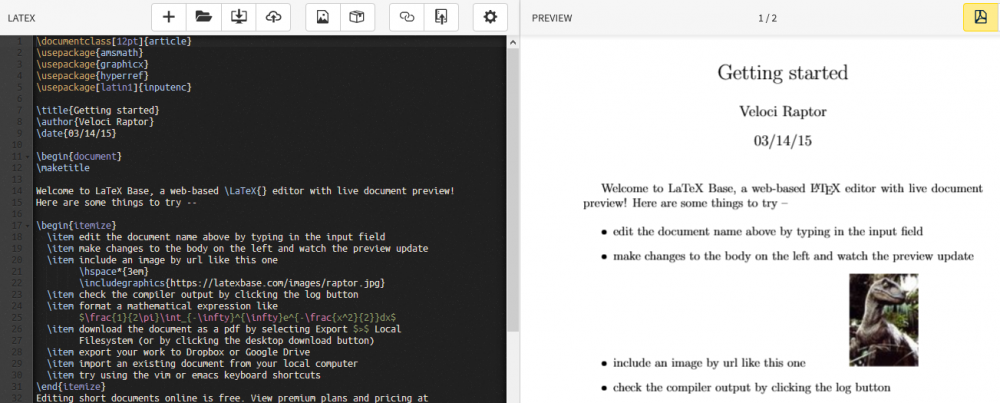
These documents are saved as .tex files and are usually exported to a PDF for printing or sharing. To proofread LaTeX documents effectively, you don’t need to know how to write LaTeX code, but you do need to understand the basics of how it works and what parts you should (and shouldn’t) edit.
How to Access LaTeX Files
When proofreading LaTeX documents, you’ll typically receive:
- One or more .tex files, which contain the content and formatting markup
- A PDF version, which shows how the document will look when compiled
If you don’t receive a PDF, it’s a good idea to ask the client for one. This helps you understand how the final version will appear, especially if the text includes equations, figures, or specific layout choices.
You can open .tex files in any plain text editor (such as Sublime Text, Notepad++, or BBEdit) or in a dedicated LaTeX editor ( TeXstudio, Texmaker, or Overleaf). However, these programs don’t support tracked changes or comments, which are essential for most proofreading work.
A well-defined process will help you manage the documents efficiently:
- Ask the client for both the .tex file(s) and the exported PDF.
- Open the .tex file using a plain text editor.
- Copy and paste the text into Microsoft Word (or another program that supports tracked changes).
- Proofread the content in Word, tracking all edits and comments.
- Accept all changes and delete any remaining comments.
- Copy the corrected text back into the original .tex file, or resave your Word document as a plain text file and rename the extension to .tex.
This workflow allows you to preserve the client’s original markup while providing clear editorial suggestions in a format they can easily review.
Understanding LaTeX Markup
LaTeX markup is easy to identify once you know what to look for:
- Commands start with a backslash (e.g., \section, \textbf, \begin{itemize}).
- Arguments are enclosed in curly brackets (e.g., \section{Introduction}).
- Comments are introduced with a percent sign (%) and are not shown in the exported document.
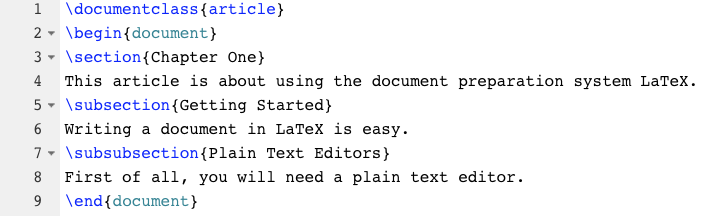
You can see how the example above would be outputted below.
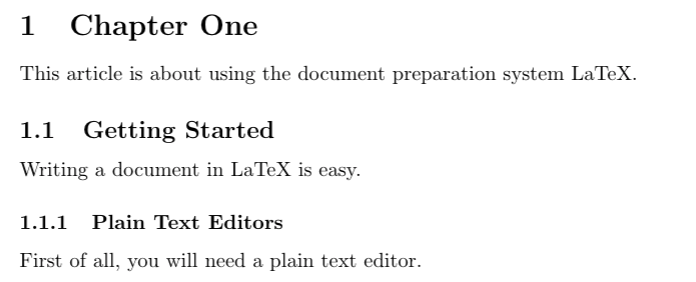
As a proofreader, you should not edit the markup unless you are confident you understand it or the client has specifically asked you to do so. Editing LaTeX code without knowing what it does can result in errors when the document is compiled.
That said, there are some exceptions:
- Heading text in curly brackets (e.g., after \section or \subsection) should be proofread and edited if needed, since this text appears in the PDF.
- If you notice an obvious error in a markup command, and you’re confident it’s incorrect, you can flag it in a comment or suggest a correction.
What You Can (and Can’t) Edit
Here’s a quick breakdown of what you can safely edit in a LaTeX document:
- Main text content (anything not part of a command) ✅
- Text within curly brackets that appears as visible content (e.g., headings) ✅
- Author comments (introduced by %), if the client requests this ✅
You should not edit:
- Markup commands (especially those starting with \documentclass, \usepackage, or \begin) 🚫
- Formatting or layout code 🚫
- Equations or figures 🚫
- Citations and bibliographies, which are usually inserted via a tool like BibTeX 🚫
If you see an error in something you can’t safely edit, such as a citation or equation, make a note in your Word document to flag it for the client.
Exporting and Returning Files
Once you’ve finished editing the LaTeX document in Word:
- Save the version with tracked changes to share with your client
- Accept all changes, delete all comments, and save a new version as plain text (.txt)
- Open this file in a plain text editor, and save it with a .tex extension
Now you can return both the .tex file (with your edits) and the Word version (with tracked changes) to the client. This gives them a clear record of what you’ve changed, along with a ready-to-export LaTeX file.
If your client is new to LaTeX or unsure how to compile the PDF themselves, you can also point them toward LaTeX tutorials online, such as LaTeX-Tutorial.com.
Final Tips for Proofreading LaTeX Documents
- Don’t panic about the markup: As long as you know what not to touch, you can proofread LaTeX content without needing to code.
- Use the PDF: Always refer to the exported version to cross-check headings, equations, and citations.
- Flag issues clearly: If you’re unsure about editing a piece of code, leave a comment explaining the issue.
- Keep formatting in mind: Avoid changes that could disrupt layout-sensitive elements like figures or equations.
Understanding how to work with LaTeX will make you a more versatile proofreader and open the door to more academic and technical work.
Learn More with Knowadays
Want to become a confident, capable proofreader, no matter the file format? Our proofreading course, Becoming A Proofreader, covers everything you need to know, including how to work with Word files, PDFs, and LaTeX documents.
Sign up for two free lessons today!







Your email address will not be published.